I am a former employee of the University of Arkansas School of Art, a predominantly white institution that was required, through the terms of an endowment, to “…be constructed as a model of inclusion and diversity.” In this context, diversity and inclusion function as institutional technologies designed to reshape who is invited to work, learn, and teach within the university across racial, economic, gender, sexual, religious, ethnic, national, and ability identities. While such initiatives promise to challenge hegemonic environments by broadening participation, they remain constrained by the very instituional logics that produce those environments. Constructed through predominantly white institutional perspectives, they can never recognize or accommodate the people they claim to include.
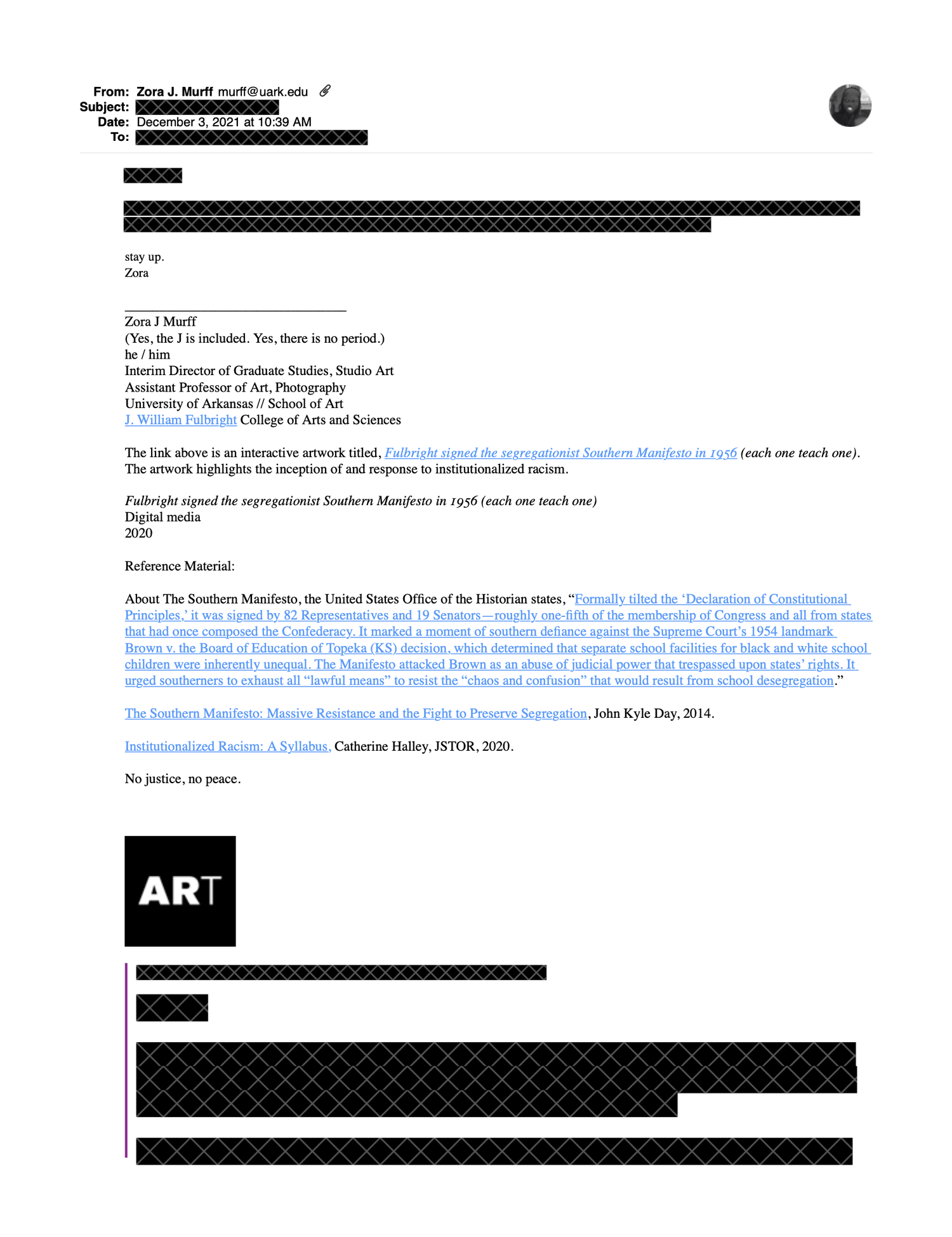
The School of Art is housed within the J. William Fulbright College of Arts & Sciences. J. William Fulbright, a former U.S. senator from Arkansas, signed the segregationist Southern Manifesto in 1956, and both a university college and a campus statue continue to bear his name. As part of my university email signature, I included a hyperlink to an X post documenting an installation by University of Arkansas student Jacob Campbell. The photograph shows Fulbright’s statue, a black sheet draped over it, with a sign propped in front of it reading, “In need of a new statue, preferably not a segregationist.” The link was intended to participate in an ongoing conversation about institutional racism within a university community that I had chosen to join and that purported to value my perspective. Univesity Relations instructed me to remove the link, citing a policy prohibiting employees from engaging in public political speech while at work. The concern was not the historical fact of Fulbright’s segregationism and the implications that holds over the University memorializing him, but the possibility that somone might complain about my participation in a public converstaion about it.
I transformed my email signaure into an artowrk by assembling publicly accessible information to a single expressive form. Fulbright signed the segregationist Southern Manifesto in 1956 (each one teach one) (2020) existed only as a hyperlink embedded in my signature, making the work avaialable to anyone who corresponded with me. By designating the hyperlink itself as an artwork, the institution was forced to confront its presence as speech and artistic practice. In doing so, the work exposed a contradiction: I had been recruited in the name of diversity and inclusion, yet was being prohibited from publicly engaging the institution’s own history of segregation through the very forms of critical inquiry my position was meant to support.